
Restoration for Repentant Nations and Families
Announcements
Restoration is a way to heal wounds in Mexico. It offers tools and reflections on how to repent and be restored. It is addressed to leaders, Shepherds, mental health professionals, employees and families who want a renewal.
Recently, there have been calls for national reconciliation and repair efforts. These happen after violence and inequality. Restoration in Mexico benefits from restorative justice, community projects and public policies. All of this helps to rebuild society.
The aim is to present a plan that mixes pastoral practices with psychological support. It also includes evidence of public policies and regional examples. It seeks to reinforce civic values, promote peaceful coexistence and improve life. This would be achieved through reconciliation and proven repentance.
Announcements
Key findings
- Promoting the national reconciliation It requires local action and community leadership.
- Repentance and restoration are necessary steps to family renewal.
- Restoration Mexico needs coordination between churches, government and civil society.
- Measuring progress with clear indicators facilitates the continuity of processes.
- The combination of psychological support and community programs increases the impact.
Importance of social restoration in Mexican communities
Social restoration in Mexico has deep roots in its history. It’s seen in local practices that repair damage and strengthen communities. It comes from experiences like land conflicts, migration and organized crime violence.
Extended family and indigenous traditions offer solutions. They remain important in both rural and urban areas.
In many municipalities, customs and traditions guide the process of reconciliation. These traditions activate social capital. They generate collective responses to inequality and divided politics.
Local resilience is based on neighbourhood networks and cross-generational support. Studies confirm the importance of social capital in this.
Historical and cultural context in Mexico
Land disputes and displacement have affected justice in Mexico. The country’s social history includes many episodes of community reparation. Memory and culture influence how dialogue and reparations are accepted.
Migration has changed family structures. This has led to new forms of community bonding. In neighborhoods and villages, people combine old knowledge with new support.
Impact of the restoration on Community cohesion
Reconciliation improves coexistence in communities. You see less violence and more civic participation by implementing peace committees. Trust between neighbours helps to start projects together.
That leads to less crime and better access to services. Cases in places like Cherán and San José del Progreso show the strength of local coordination.
Indicators of success in Community proceedings
Various information is used to evaluate restoration. There is less crime and more use of mediation. Also, there is more attendance at assemblies.
Perceptions of security and improved relationships are analyzed. Surveys and interviews help to understand the long-term impact.
| Type of indicator | Example | Measuring instrument |
|---|---|---|
| Quantitative | Reduced crime rates in 12 months | Police records and municipal statistics |
| Quantitative | Increase in complaints resolved through Community mediation | Reports of peace committees and local prosecutor’s office |
| Qualitative | Security perception among neighbours | Door to door searches and focus groups |
| Qualitative | Conciliation witnesses and family catering | Semi-structured interviews and Community reports |
| Methodology | Longitudinal follow-up | Annual monitoring and baselines |
Restoration for Repentant Nations and Families
Before discussing the subject, it is important to have a good understanding of what is involved. Restoration means admitting the damage, looking for ways to repair it and trying to forgive and trust again. This is needed both at home and in society.
Definition and scope of the term
Restoration brings together justice and reparation. It combines legal punishment with efforts to mend broken relationships.
This concept applies to households and national programmes. It seeks to solve the problems of individuals and groups affected by conflict or abuse.
Why Repentance Is Key to Renewal
To improve a country or relationships, acknowledging mistakes is the first step. It helps you to be forgiving.
Taking responsibility, understanding others and taking action to correct mistakes are important steps. Public apologies from the institutions are essential to repair and regain people’s trust.
Examples of transformation at national and family level
In the countryside, dialogues after land disputes brought peace and plans to live better together.
In families, dealing with problems with professional help has healed relationships. It’s improved how they take care of each other and talk to one another.
Latin American countries have good examples of how to solve problems in one country. These examples show that genuine repentance can bring lasting changes.
Practical steps to initiate repentance and reconciliation processes
Starting to repair relationships is not easy, but it is possible with steps adapted to each situation. We present a series of actions for families and communities in Mexico to repair broken bonds.
Self-assessment and recognition of injury
It all starts with self-assessment. To do this, using lists that show how you hurt others is helpful. A diary can help us better understand our behaviors and feelings.
It is important to write about what happened, who was affected and how. This helps to remind us of the harm done and is vital for open communication.
Local leaders can organize workshops where conflicts are mapped. This gives a clear picture of what happened and its effects on the community.
Guided talks and mediation
For dialogue, there are simple rules such as speaking in turn and respecting others. A mediator keeps this space safe and orderly.
In the family mediation, It is essential to have trained mediators. You can use techniques like peace circles to help.
You should prepare well for the meeting, choose an appropriate time and offer to accompany. Thus, the conversations will be more than just a meeting.
Concrete commitments and action plans
Agreements shall be clear and enforceable. A well-defined plan sets out these commitments in a formal way.
Some examples are apologizing, making material compensation or doing community service. It’s also good to attend workshops to understand and repair the damage.
The key is to set dates, assign responsibilities and have a system for checking progress. With constant review, the agreements are fulfilled and modifications can be made if necessary.
| Stage | Employment | Responsible | Indicator |
|---|---|---|---|
| Diagnosis and treatment | Checklists and reflective diary | Individual / family | Registration of facts and affectations |
| Preparation | Community offices and mapping | Local leaders | Map of conflicts and priorities |
| The dialogue | Guided dialogue and family mediation | Certified mediator | Agreements signed and minutes |
| Commitment | Design of SMART commitments | Parties involved | Reconciliation plans with deadlines |
| Follow-up | Periodic review and adjustments | Monitoring committee | Reporting and Compliance Percentage |
Role of Faith and Churches in Family Restoration
Faith brings together human and spiritual resources that help reconcile Mexican communities. Churches serve as safe havens. They provide emotional support, legal counsel and service connections.
This ensures that the family catering be more than just words. It leads to real, positive changes in how families live together.
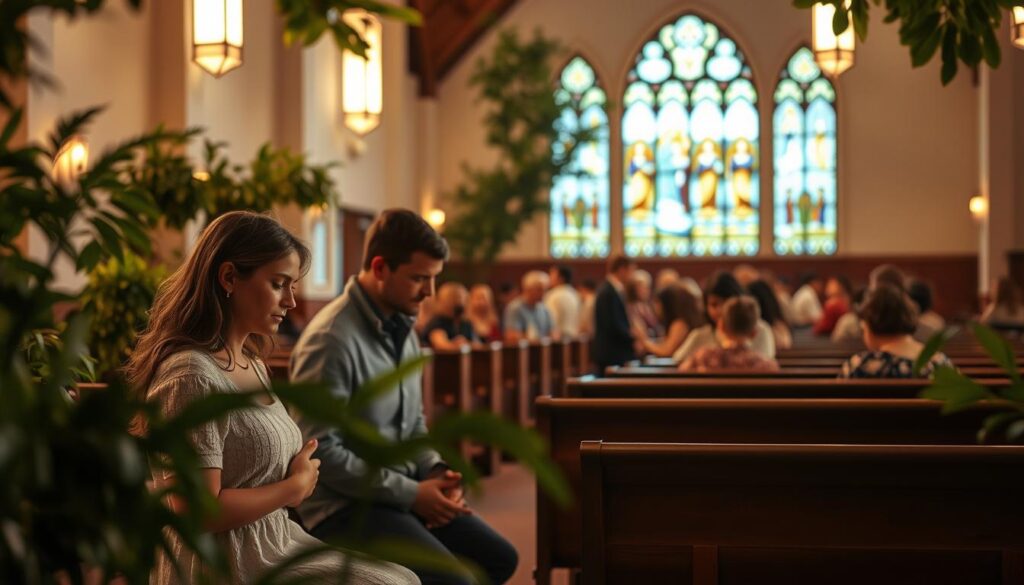
It is vital that the pastoral programs are raised with technical knowledge and cultural understanding. Couples’ workshops and counseling are common practice. Retreats and forgiveness circles are very helpful in repairing relationships.
Training leaders on issues like domestic violence and human rights improves interventions. Such training also helps to reduce risks and promotes the use of appropriate medical or legal services. Thus, programmes have more impact and avoid working in isolation.
The stories of families who have settled their differences are very powerful. These stories show tangible improvements such as fewer fights and better organization at home. They help inspire more efforts to help other families.
Working together broadens what can be achieved. Cooperation between churches, health centres and community groups makes it possible to provide more comprehensive help. This includes legal advice, temporary financial support and networks to prevent future problems.
To be more effective, it is good to have coordinated strategies and share resources. Shared training and having a clear course of action help churches work better together. This is a key to helping families in difficult situations.
| Action to be taken | Purpose | Key players | Expected result |
|---|---|---|---|
| Pre-marriage offices | Strengthening communication and roles | Shepherding, counselors and couples’ facilitators | Better Understanding Before Marriage |
| Reconciliation withdrawals | Creating space for in-depth dialogue | Local churches, trained mediators | Conflict resolution and emotional closure |
| Circles of forgiveness | Restoring Bonds by Witnessing | Community facilitators, psychotherapists | Rebuilding Trust and Forgiveness |
| Social and economic support networks | Consolidating processes with material aid | Churches, civil organizations and health centers | Stability that allows reconciliation to be sustainable |
| Pastoral training | Improve case detection and referral | Seminars, universities and NGOs | Safe and professional service |
Public policies favouring national restoration
The public reparation policies They are the key to healing all of society’s wounds. Good design helps with both material and symbolic repair. It’s also vital to reintegrate people who have suffered harm.
The state uses tools like truth commissions and protocols to help victims. In Mexico, the General Law for Victims shows how to carry out such programs at all levels.
It is important that government programmes address urgent needs and work on long-term solutions. For example,, projects include rehabilitation, emotional support and financial help, always in partnership with the municipalities.
If we start teaching civic education at an early age, we will strengthen democratic principles. Children must learn about conflict resolution, empathy and their rights to create better conditions in schools.
In addition, activities such as peace clubs and school mediation reduce violence among students. These promote peace and teach young people to get along better.
Working together, society and government greatly improves aid programs. Signing agreements to provide training and fund projects makes communities more involved in the process of healing a country.
NGOs play a key role in supporting victims, thanks to their experience. Working with them requires clear rules and transparency to ensure that projects succeed.
Some suggestions include making programs with community help, setting clear goals and educating teachers in values. These steps are essential to linking remediation efforts with those of the national reconciliation.
Psychological and emotional tools for families in process
Families who are beginning to repair their bonds need help that is readily available. Here are techniques and methods for dealing with difficult feelings and how to find support. All to help them improve and reconnect with each other.
Family therapies: systemic family therapy examines familial relationships and roles. Cognitive behavioral therapy for families focuses on changing thoughts and habits. Narrative and emotion-centered therapies help to retell stories and validate emotions. Specialists such as psychologists and family therapists offer support throughout the process.
Emotional counseling: Emotion control methods such as deep breathing and sensory techniques are taught. Cognitive restructuring separates useful thoughts from harmful ones. A treatment plan sets goals and reviews to track progress.
Dealing With Grief, Guilt and Forgiveness: techniques such as journaling and role-playing exercises for forgiveness are used. It’s key to differentiate between healthy guilt and destructive guilty. A specialist helps you manage your grief without reliving the pain.
Free psychological services: In Mexico there are centers that offer help at little or no cost. Organisations and helplines offer advice and guidance. They usually just ask for some personal information and sometimes a preliminary evaluation.
To begin, have an evaluation with a specialist. Seek local references and support from religious communities or community centres. Combining family and emotional therapy helps. Find free resources and community mental health services near you.
Education and the transmission of values in family catering
Teaching respect and responsibility requires clear strategies in every family. THE education in values Daily journaling strengthens bonds and helps bring about reconciliation at home.
Educational models based on respect and reconciliation
There are approaches like social-emotional learning, restorative pedagogy and human rights education. They promote empathy, conflict resolution and self-responsibility.
Schools in Mexico are using these models to improve teaching. Restorative practices turn mistakes into lessons and empower family values.
Practical activities for parents and children
Making weekly family circles improves communication and helps to share feelings.
Role-playing and home projects, such as a garden, enhance togetherness.
A calendar of dinners and moments of gratitude helps keep the practice going. These techniques are adapted to different ages and contexts, whether urban or rural.
Recommended materials and programmes
It’s good to look for resources that have evidence of success and are culturally appropriate. UNICEF Mexico has useful guides for home and school.
The National Institute for Educational Assessment and other associations provide resources. They offer easy-to-use textbooks and educational programs.
There are special materials for parents in Mexico, including guides and lists of activities.
Practical advice: Mix an SEL model with family activities and revise materials frequently to meet family and community needs.
Economy and restoration: rebuilding thriving environments
The economy plays a key role in social recovery. A strong family environment boosts the economy and reduces spending on safety and health. Working together, we enhance local economic development and make our community more attractive to investors.

Economic impact of family stability in the community
Emotionally and economically supported families increase their children’s attendance at work and school success. According to the OECD and World Bank, social capital is linked with growth. This connection shows that social welfare means less spending for the public and more happiness for everyone.
Productive projects and social entrepreneurship
Cooperatives, small family businesses and social enterprises help women and young people integrate into the economy. NGOs and government programs have proven that these projects improve the community.
In Mexico, social entrepreneurship benefits from supportive policies. These projects create jobs, improve incomes and strengthen communities.
Access to finance and training
Microloans and aid schemes offer financing to households. Training in subjects such as accounting and marketing improves a business’ chances of success.
It is a good idea to combine training with technical support and market access. Crowdfunding initiatives and government support help projects grow and become sustainable.
| The element | Benefit | Example of support |
|---|---|---|
| Stable families | Increased productivity and reduced public spending | Local welfare and education programmes |
| Co-operatives | Employment inclusion and the value chain | Advice from CONCAMIN and NGOs |
| Microcredits | Affordable start-up capital | Microfinance institutions and regional funds |
| Training | Improved management and market access | Municipal offices and online courses |
| Social entrepreneurship Mexico | Empowerment and sustainability | Incubation networks and impact funds |
Success stories in Latin America applicable to Mexico
In Latin America, there are valuable lessons to be learned about reconciliation and social restoration. These cases show agreements, truth commissions and repair programmes. These are examples with both symbolic and material measures, important for policies in Mexico.
Patterns that have marked the region
Colombia has achieved peace and reparation with its agreements. Guatemala has documented violence and justice with its commissions. Peru and Chile stand out for their transitional justice, with truth and reparation.
Common elements in the proceedings
- Acknowledgement of harm and participatory truth are key.
- They combine symbolic redress with material compensation.
- They ensure that mistakes are not repeated and the community is involved in decisions.
Lessons learned and good practice
Local participation is key to long-term success. Sensitive cultural practices and multidisciplinary teams enhance the programmes. Continuous evaluation is also vital.
Long processes that can be evaluated create more trust. Accountability and working together are crucial: State, civil society and international bodies. Combining symbolic and material reparations increases acceptance.
Adaptation to the Mexican context
Adaptation in Mexico requires legal adjustments that consider indigenous traditions. It is important to design taking into account the federal structure of the country.
High-conflict piloting is suggested. Collaboration with universities and research centres improves these projects.
Operational recommendations
- It’s important to map local cases and key players.
- Projects are validated by the Community participation mechanisms.
- There must be clear indicators and accountability.
- It’s key to combine symbolic repairs with materials.
The experiences of Latin America provide useful examples for Mexico. Applying these lessons with local care can make initiatives more effective.
Common obstacles in appeal proceedings and how to overcome them
Repentance processes have barriers everywhere. Knowing these challenges is key to creating solutions. Next, we’ll explore common obstacles and how to overcome them.
Culture can make repair difficult. Issues like pride, fear of showing vulnerability and normalizing the damage are barriers. Moreover, distrust of authority increases resistance.
Cultural resistance
Using campaigns that tell real experiences helps change mindsets. Local leaders can lead by example and gain trust. It is also vital that we have safe places to share our grief.
Lack of resources and institutional coordination
Initiatives often fail for lack of money and adequate staff. Slow turnarounds are also a problem. Municipalities, states and civic groups need to work together to coordinate efforts.
Training staff and investing in the right policies improves results. Working together internationally brings funds and technical expertise.
Strategies for maintaining continuity of the process
For efforts to last, plans for the future are needed. Funding on a consistent basis and having local leaders involved are key. Residents’ committees and collaborating with schools and churches establish good practices.
Continually assessing progress and adjusting as necessary is key. Clearly defined objectives help to keep the project focused and move it forward.
| The obstacle | The impact | Practical Solution |
|---|---|---|
| Pride and Fear of Vulnerability | Silence between victims and perpetrators prevents reconciliation | Guided testimonies, safe spaces and exemplary leadership |
| Standardization of violent conduct | Cultural resistance that legitimate damage | Educational campaigns in schools and communities |
| Insufficient budget | Partial or intermittent projects | Prioritizing public resources and alliances with donors |
| Lack of trained staff | Ineffective care and loss of trust | Local training and certification programmes |
| Bureaucracy and lack of coordination | Delay in action and duplication of effort | Interinstitutional tables and clear protocols |
| Lack of follow-up | Projects fade with time | Local committees, participatory monitoring and indicators |
How to measure and evaluate restoration in nations and families
To measure social processes, clear methods are needed. Combining data with personal stories is key. So we better understand the impact on homes and communities.
Indicators are concrete signs of progress. They mix numerical data with personal experiences. This balance prevents wrong conclusions.
Among the quantitative indicators are reduced crime and improvements in schooling. Qualitatives include testimonials and perception of safety. Together they make a complete picture.
Assessing restoration is more valid when the community intervenes. In Mexico, participatory assessment uses surveys and focus groups. So you see changes that the numbers don’t show.
Training local leaders improves the information collected. Through workshops, they learn how to collect and record data. This strengthens the sustainability of the project.
Clear reporting ensures transparency. They should be easy to understand. Sharing them in public audiences builds trust.
Disseminating the results to local media improves the project. Posting progress and asking for feedback helps to make appropriate adjustments.
The following is a comparative guide to useful indicators and tools. It is designed for municipalities and community organisations.
| Area | Quantitative indicators | Qualitative indicators | Participatory evaluation tools | Accountability mechanisms |
|---|---|---|---|---|
| Security of the Community | Reduction in reported incidents; number of complaints handled | Perception of security; reports on living together as neighbours | Focus groups with neighbours; participatory risk maps | Public hearings; monthly bulletins with figures |
| Access to services | Rate of use of mental health services; programme assistance | Satisfaction with service; trust in providers | Participatory research; semi-structured interviews | Open data platforms; quarterly reports |
| Education and youth | Tuition and attendance fees; participation in workshops | Perception of school support; testimonies from teachers and families | Peer evaluation in schools; participatory workshops | School follow-up committees; public presentations |
| Local economy | Local employment; number of productive projects | Confidence in opportunities; reports on family impact | Mapping of actors; surveys on entrepreneurs | Disclosure of economic indicators; feedback sessions |
| Family relations | Therapy and counselling assistance; participation in programmes | Quality of relationships; stories of reconciliation | Guided support groups; in-depth interviews | Local reports; follow-up by citizens’ committees |
Conclusion
The restoration process teaches us the importance of acknowledging harm and asking for genuine forgiveness. It also shows that real action and working together across sectors is needed. To achieve reconciliation, We combine the methods of religion, and psychology, education and the economy. So we repair relationships in families and communities.
To begin restoration, families should talk and seek professional help. Churches can give support and instruction to their leaders. Governments have to make policies that last for the long term. Ordinary people should help by watching and actively participating. By following these steps, we can turn good intentions into real results.
It’s crucial to invest in civic education and measurable methods for strengthening our societies. We can start now: finding local mediators, attending workshops in the community, and joining specialized groups. These efforts can create positive and lasting change in Mexico.
FAQ
What is meant by “Restoration” in the context of repentant nations and families?
Restoration involves different actions such as damage recognition and reparation. It includes both symbolic and practical acts. It’s about reconciling and regaining trust, whether in families or communities.
Why is repentance a key to social and family renewal?
Genuine repentance opens the way to forgiveness and heals relationships. It shows a real commitment to personal betterment. On a broader level, it promotes the creation of conditions for reparation and restores social trust.
What are the indicators for measuring the success of a Community restoration process?
Aspects such as the lower incidence of crime and community participation are measured. They are also considered personal testimonies of reconciliation. To this end, research and monitoring over time are used.
How can a family begin the process of repentance and reconciliation?
First, an honest appraisal of harmful conduct. Then start dialogues, maybe with outside help. At the end, set clear commitments that are safe for everyone.
What mediation techniques are recommended for family or community dialogues?
It is helpful to have clear rules and a professional mediator. It’s important to take turns talking. Peace circles and restorative dialogue are very effective.
What role can churches and faith communities play in the restoration?
Churches support with retreats and counseling, among other services. They collaborate with other institutions and train leaders to contribute to healing processes.
Are there any free resources or services in Mexico to support restoration processes?
Yes, there are a variety of services from care centers to municipal programs. Local churches and helplines are also a good option.
How do restorative justice and legal sanction integrate into these processes?
Restorative justice focuses on repairing relationships and promoting reconciliation. This is complemented by the legal system, which ensures accountability for acts.
What psychological tools help to manage guilt, grief and forgiveness within restoration?
Techniques such as emotional regulation and systemic family therapy are employed. Narrative approaches and professional support to avoid re-victimization are also helpful.
How can schools contribute to conflict restoration and prevention?
Incorporating social emotional learning and mediation practices. Extracurricular programs, such as peace clubs, are key to improving coexistence.
What kind of public policies favour restoration at national level?
Those that include truth commissions and comprehensive redress programs. In addition, cooperation between government and society is vital to ensure resources and transparency.
How can productive projects supporting community restoration be financed?
Micro-credit, government programs and crowdfunding are available. Training and technical support are key to its sustainability.
What obstacles are most common in repentance processes, and how can they be overcome?
Common challenges include: cultural resistance and lack of resources. They are overcome by raising awareness and combining efforts from different sectors to obtain funds and support.
How does a reconciliation initiative from another region in Latin America fit into the Mexican context?
It should be adapted to local traditions and the specific conditions of Mexico. Community participation is encouraged and collaboration with various institutions to fine-tune methodologies.
What participatory tools are used to evaluate restoration processes?
Tools like focus groups and surveys allow you to engage the community. Combining different types of data helps to understand the impact more fully.
What good practices ensure transparency and accountability in restoration projects?
Publishing comprehensible reports and holding public hearings are key actions. This, together with ongoing feedback, strengthens the relationship with beneficiaries and improves strategies.