Anúncios
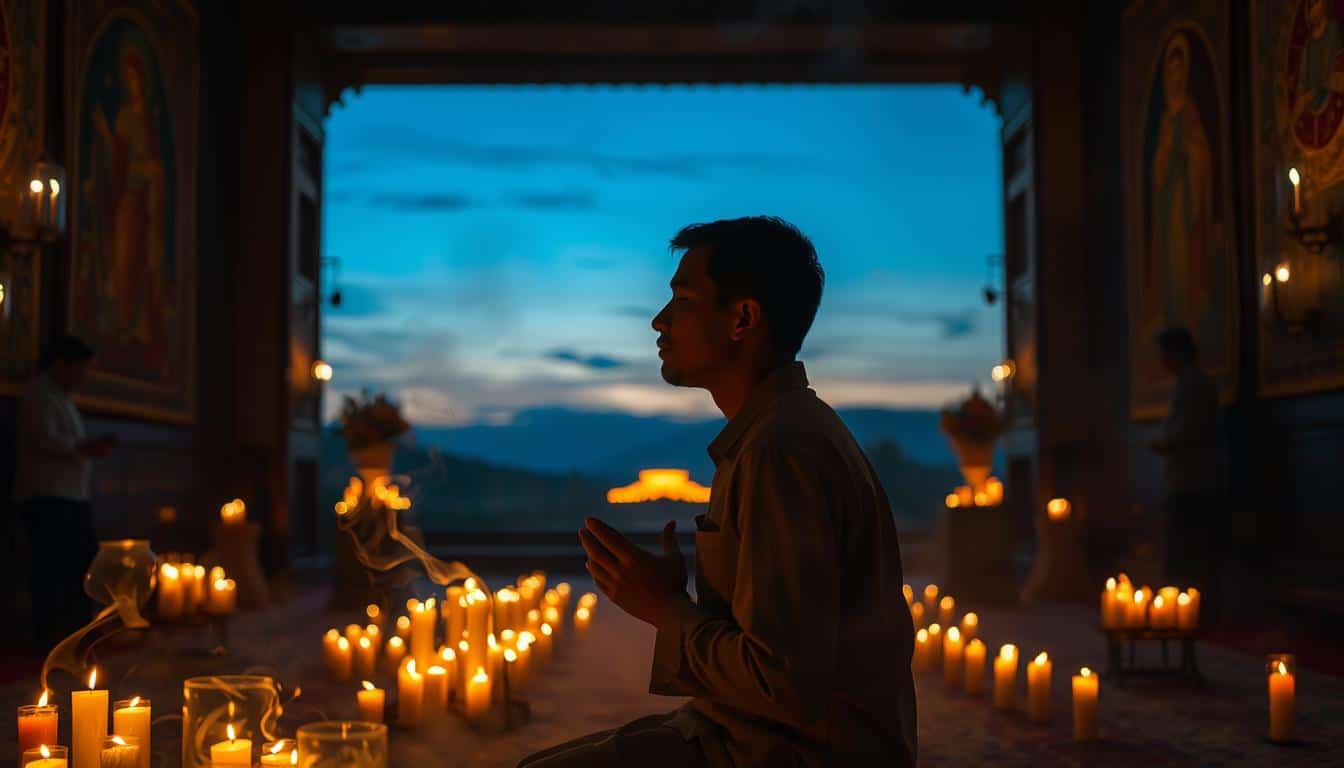
Prayer is key to improving our spiritual life and finding inner calm. It helps us connect more deeply with God. This, in turn, aids our personal growth through these conversations. We aim for qualities like wisdom, humility, and love—qualities Jesus showed us.
“Dear God, help me get closer to You today. Shape my heart to mirror Your love and truth,” can change us. Praying like this often lets us approach God’s throne confidently for help. It can be asking for strength or understanding but always brings blessings and insight into our lives.
Understanding Spiritual Growth
Spiritual growth is a key part of becoming a better person. It’s based on the Bible, showing us how to live. Take Jesus’ story in Luke 2:52, for instance. It shows Him growing in wisdom and favor with God and others. This teaches us that growing spiritually is a constant journey. It’s about building a strong bond with God.
Anúncios
Praying is at the core of this growth. It lets us talk directly to God. It’s vital for becoming spiritually stronger. Using the Abide app can make praying more impactful. It offers daily prayers and teachings, helping believers connect with God’s words. Tools like these are great for keeping us in tune with spiritual teachings daily.
Being humble in prayer is also very important. When we open our hearts, we let God make big changes in us. This can improve not just us, but also our relationships and communities. Thinking about our actions and trying to live as God wants us to are key. These habits help us grow closer to God. They show what it means to truly grow spiritually every day.
Prayer can be a living path, not just a routine. It can become the quiet place where your heart learns to breathe again, where your spirit is strengthened day by day, and where peace slowly returns even when life outside remains loud, uncertain, or painful. Spiritual growth is not something that happens all at once. It unfolds gently through repeated surrender, through small acts of faith, through conversations with God that continue even when you don’t feel strong, even when you don’t have the perfect words, even when you are tired and simply need comfort.
Prayer is often misunderstood as something we do only when we want something specific. But prayer is deeper than requests. Prayer is a relationship. It is presence. It is alignment. It is the daily choice to lift your thoughts beyond fear and to anchor your soul in the One who does not change. When you commit to prayer as a spiritual practice, you are not only seeking answers—you are allowing your inner world to be transformed.
One of the most powerful ways prayer supports spiritual growth is by teaching you to listen. Many people speak in prayer but rarely pause to hear. Yet spiritual maturity develops when you create space for silence, when you allow your spirit to be still long enough to receive. Sometimes God speaks through peace that settles on you unexpectedly. Sometimes He speaks through an insight that arrives like light. Sometimes He speaks through a scripture that suddenly feels personal. And sometimes He speaks by simply holding you close, even when nothing is explained.
To grow spiritually, you must learn that prayer is not measured by how emotional it feels, but by how faithful you remain. There will be seasons when prayer feels effortless, and other seasons when prayer feels like walking uphill. Both seasons matter. The days you pray with joy matter. And the days you pray through heaviness matter even more, because those are the moments when you are building endurance, humility, and trust.
A heart that desires peace must learn to release control. Peace is not something you force. Peace is something you receive when you lay down your burdens. Prayer becomes the act of handing over what you cannot carry alone. When you pray, you admit that you are human. You admit you have limits. You admit you need help. And in that surrender, you create room for peace to enter.
It can be difficult to pray when your mind is overwhelmed. Thoughts can feel scattered. Anxiety can interrupt you. Doubt can speak louder than faith. But the beauty of prayer is that it doesn’t require perfection. You don’t have to pray in long speeches. You can pray in whispers. You can pray in tears. You can pray in a single sentence repeated with sincerity: “God, help me.” There is power in simple prayer, because God listens to the heart, not the performance.
If you want prayer to become guidance for spiritual growth and peace, it helps to begin with consistency. You don’t need to pray for hours to grow spiritually. You need to pray regularly and truthfully. A few minutes each day with a sincere heart can change the direction of your inner life. Prayer becomes your spiritual rhythm, the place your soul returns to for clarity, strength, and renewal.
You may find it helpful to structure your prayer life in a way that supports your spiritual journey. One approach is to begin by centering yourself. Take a deep breath. Close your eyes. Become aware of the presence of God. This moment is not about rushing. It is about coming home. Say something like, “Lord, I am here. I need You.” Even that alone is a powerful beginning.
After that, you can move into gratitude. Gratitude is not denial of pain. Gratitude is recognition that even within pain, God has not abandoned you. Gratitude changes the atmosphere of your mind. It softens bitterness. It loosens the grip of stress. It reminds you that you are not only surviving—you are still being supported. You might thank God for small things: a breath, a sunrise, a person who cares, an opportunity to start again. Spiritual growth often begins when we learn to see blessings without needing life to be perfect.
From gratitude, you can move into confession and cleansing. Confession is not about shame. It is about freedom. It is about clearing the weight you have been carrying quietly. Spiritual peace grows when your soul is not hiding, not pretending, not carrying secret guilt. You can say, “God, forgive me for the ways I have drifted, for the anger I’ve held, for the fear I’ve trusted more than You.” You are not confessing because God is harsh, but because God is healing. Confession is a doorway into peace because it removes the inner conflict between who you are and who you want to become.
Next comes surrender. This may be the most important element of prayer for peace. Surrender is where you release your plans, your anxieties, your need to control outcomes. It is where you say, “Lord, I give You what I cannot fix.” Surrender doesn’t mean you stop trying. It means you stop carrying the weight alone. Spiritual growth requires surrender because pride blocks transformation. When you surrender, you become teachable. You become guided. You become open to divine wisdom.
Then, bring your requests. Ask boldly, but with humility. Ask for strength. Ask for clarity. Ask for healing. Ask for wisdom. Ask for doors to open. Ask for relationships to be restored. Ask for peace in your home, in your mind, in your spirit. God does not despise your needs. Prayer is where you bring your whole self. The key is not to pray only for outcomes, but also for inner transformation. Instead of praying only, “Change my situation,” also pray, “Change me in this situation.”
Prayer for spiritual growth often includes asking God to develop qualities in you that don’t come naturally. Ask for patience when you are tempted to react quickly. Ask for forgiveness when you want to hold on to resentment. Ask for courage when you feel afraid. Ask for discipline when you want to quit. Ask for love when your heart feels tired. These prayers shape your character, and character is the foundation of spiritual maturity.
When you pray for peace, remember that peace is not the absence of struggle. Peace is the presence of God inside the struggle. Peace is the ability to rest inwardly even when life outside is still messy. Peace is the assurance that no matter what happens, you are not alone. You can pray, “Lord, settle my heart. Calm my mind. Let Your peace guard me.” You may not feel immediate relief every time. But prayer works like water on stone. It shapes you gradually. It smooths sharp edges. It creates stability where fear used to live.
Spiritual growth also requires that prayer becomes honest. Many people feel pressure to sound spiritual, to say the right things, to be impressive. But prayer is not for performance. Prayer is for connection. God already knows what is happening inside you. He knows what you are afraid to admit. He knows the thoughts you can’t explain. And He invites you to bring those things into the light.
If you are angry, you can say, “God, I feel angry and I don’t understand.” If you are exhausted, say, “God, I feel weak. Carry me.” If you are grieving, say, “God, I am hurting. Comfort me.” These prayers are not failures. They are openings. They are evidence that you trust God enough to be real.
One of the most comforting truths about prayer is that even when you don’t have words, God still understands. There are moments when all you can do is sit in silence and breathe. Even that can be prayer. Even that can be worship. Sometimes spiritual growth happens when you simply remain in God’s presence, not to ask for anything, but to be held.
Another way prayer brings guidance is by sharpening your discernment. As you grow spiritually, you begin to notice what drains you and what strengthens you. You recognize patterns of temptation. You become more aware of emotional triggers. You learn to pause before reacting. Prayer becomes the practice of inviting God into your decision-making. You begin to ask, “Is this aligned with my purpose?” “Is this relationship healthy?” “Is this opportunity from God or from my ego?” Peace grows when you stop rushing into choices that cause regret.
Daily prayer can become your spiritual compass. It helps you recognize when you are drifting from your values. It helps you realign when you are tempted to compromise. It helps you see yourself clearly, not in self-hatred, but in truth. And truth brings freedom.
Prayer also nurtures peace by reminding you that you are loved. Many people live as though they must earn love through achievements, perfection, or approval. But in prayer, you return to a deeper identity. You are not defined by what you produce. You are defined by who created you. When you pray, you step out of striving and into belonging.
If you want your prayer life to lead you into deeper spiritual growth, consider including scripture or sacred reading. Prayer and truth work together. Sometimes your emotions will lie to you. They will tell you that you are alone, that you will never change, that nothing will improve. But truth interrupts those lies. When you pray with spiritual truth in your heart, your mind begins to renew. You start to think differently. You start to respond differently. You start to see the world through faith instead of fear.
Peace also increases when you learn to pray for others. Intercession is a powerful way to grow spiritually because it expands your heart beyond your own concerns. When you pray for someone else’s healing, clarity, protection, or peace, you participate in compassion. You become less self-absorbed and more spiritually sensitive. Sometimes your own pain feels lighter when you remember you are part of something bigger than your struggles.
Prayer is also a place where you can receive strength for the ordinary. Spiritual growth is not only about major breakthroughs. It is about faithfulness in small things: kindness when you are tired, integrity when nobody is watching, patience when you are frustrated, humility when you are successful. Prayer gives you strength for daily life. It helps you keep your heart clean. It helps you keep your spirit open. It helps you keep your eyes on what matters.
If you are seeking peace in your mind, prayer can be combined with gentle spiritual habits: slowing down, breathing deeply, speaking words of trust. You might repeat a simple prayer throughout the day: “God, I trust You.” Or: “Lord, lead me.” Or: “Peace, be still.” These short prayers can interrupt anxiety and bring you back to the presence of God.
There will still be days when you feel unstable, uncertain, or emotional. That does not mean prayer is not working. It means you are human. Spiritual growth does not remove feelings. It teaches you how to hold them without being controlled by them. Prayer helps you create space between what you feel and what you believe. It reminds you that emotions are real but not always reliable. Peace grows when you learn to stand on faith even while emotions shift.
Sometimes peace arrives not as a sudden miracle but as a quiet change. You may notice that you react differently than you used to. You may notice that you forgive more easily. You may notice that fear has less power over you. You may notice that you are more patient. These are signs of spiritual growth. They are evidence that prayer is shaping you.
Prayer is also where you learn to trust timing. Many anxieties come from wanting answers too quickly. But spiritual peace comes when you accept that growth is a process. God does not rush your healing. He does not waste your waiting. Prayer teaches you to be faithful in the in-between, to keep believing even when you don’t yet see results.
In your journey toward spiritual growth and peace, remember that prayer is not a task on a checklist. It is a lifeline. It is a relationship. It is the place you can return to again and again, no matter how you feel, no matter what you have done, no matter how complicated life becomes.
The more you pray, the more you will recognize that peace is not something you chase—it is something you receive. Spiritual growth is not something you force—it is something God develops in you as you stay close. Each prayer becomes another step forward, another layer of fear released, another moment of trust built.
And over time, you will find that prayer does not only change your circumstances. It changes you. It strengthens your spirit, softens your heart, and anchors you in a peace that holds steady even when the world does not.
FAQ
Why is daily prayer important for spiritual growth?
Praying every day helps us grow closer to God and find peace inside. It makes us want to live like Jesus, asking for wisdom and love. By talking to God regularly, we stay on track with our spiritual goals.
How can I incorporate prayer into my daily life?
You can pray more by setting aside time in the morning or evening to talk to God. Apps for daily devotionals also make it easier to pray and grow spiritually.
What role does humility play in prayer?
Being humble in prayer means coming to God with an open heart. This lets God work in us, changing our lives and how we connect with others for the better.
How does spiritual growth relate to biblical teachings?
Our spiritual growth is based on teachings from the Bible, like in Luke 2:52. That verse shows Jesus growing in wisdom, which inspires us to grow closer to God and learn from spiritual lessons.
What are some practical prayers for personal growth?
For personal growth, try praying for direction, strength, and to understand your purpose. You might say, “Dear God, give me the strength and wisdom to show Your love in everything I do.”
How does reflection enhance the practice of prayer?
Reflecting on what we’ve done and God’s laws helps us see how we’ve grown. It encourages us to keep seeking God’s guidance in our lives.
Conteúdo criado com auxílio de Inteligência Artificial